
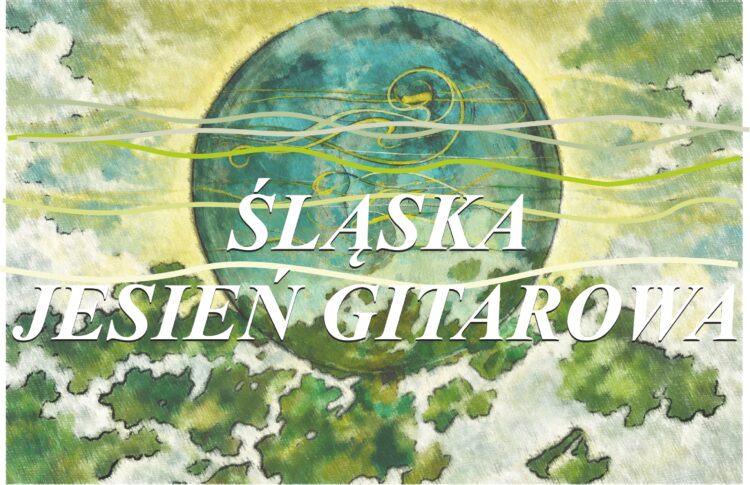
The prestige of the International Guitar Festival and Competition “Silesian Guitar Autumn” in Tychy was determined not only by the exceptional quality of its programme, the presence of the world’s leading guitarists, and the outstanding symphony orchestras accompanying them. An equally important element in building the festival’s reputation was the visual design created consistently over nearly three decades by Lech Kowalczyk. From the first edition in 1986 through the fourteenth, spanning 28 years, the artist designed stage sets, most of the posters, brochures, programmes, printed materials, outdoor advertising, promotional items, the graphic design of CDs, and the festival trophy. Archival sources confirm his involvement as early as the first festival programme, while later materials identify him as the creator of the stage designs and visual presentation, as well as a participant in the work of the festival’s organising committees.
This work gave the “Silesian Guitar Autumn” a distinctive visual language of its own—evocative, elegant and ever-changing, yet always recognisable. The individually designed stage sets were not merely decorations, but a visual “extension of the field in which music operates”. Through light, colour, space, sculptural forms and rhythm, they helped shape the atmosphere of each concert. Their originality was also noted in festival reports: the stage design was described as a permanent and distinctive feature of the event, gradually becoming part of its unique signature style—something anticipated, discussed, appreciated and remembered. In this way, music and image formed a unified artistic whole, creating an atmosphere remembered by audiences, guests, observers, jury members and performers alike, including Costas Cotsiolis, Badi Assad and the Assad Family, Al Di Meola, Marcin Dylla, Jordi Savall, and Marek Moś with the AUKSO Chamber Orchestra of the City of Tychy. It was precisely this consistent synergy of music, stage design and visual identity that helped establish the festival’s distinctive reputation.
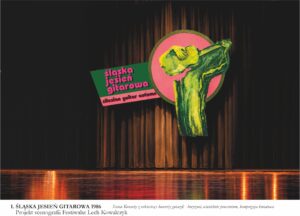
Photo: Lech Kowalczyk, Silesian Guitar Autumn 1986
Stage design by Lech Kowalczyk at the Mały Theatre in Tychy.
Two Languages of a Single Art
For twenty-eight years—from the first to the fourteenth edition of the International Guitar Festival “Silesian Guitar Autumn” in Tychy—stage design helped shape the festival’s image, atmosphere and visual identity. It evolved beyond the mere design of an event’s setting, becoming an attempt to create a different visual language—one that need not be static, but could meet the language of music as it flowed and undulated through space.
What mattered most was the interweaving of two artistic disciplines—music and the visual arts. The guitar is an instrument with an extraordinary power to evoke images and emotions. Its music draws on both classical tradition and modernity, while also carrying elements of folk cultures: Spanish, Cuban and South American. Ritual, dance, melancholy, vitality and silence converge in its sound. This diversity of musical worlds called for a corresponding exploration of visual forms.
The stage designer sought to find visual equivalents for these worlds—not to illustrate the music, but to try to touch its mystery through another language. Light, colour, material, rhythm, space and sculptural forms became the means of creating atmosphere. The stage design was intended to remain in the background, allowing music to retain its leading role while, at the same time, coexisting with it and enriching the audience’s experience.
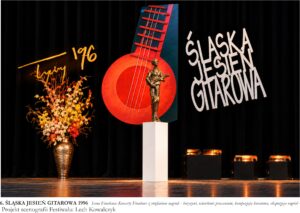
Photo: Lech Kowalczyk, Silesian Guitar Autumn 1996
Stage design by Lech Kowalczyk at the Mały Theatre in Tychy.
Direct conversations and consultations with performers proved particularly important. The collaborative search for the right space for the music played a significant role in concerts featuring artists such as Badi Assad and the Assad Family, Jordi Savall, Ana Vidović, Marek Napiórkowski, Jarosław Śmietana, Tantalus Quartet and José Antonio Rodríguez. Their musical visions became the inspiration for creating individual stage worlds. These were not ready-made sets conceived in advance and imposed upon the performers. They emerged through dialogue—as attempts to translate musical expression into the language of images.
The stage designer always remains “in the shadows”. His task is not to compete with the virtuoso, but to create a space in which the performer’s art can resonate more fully. And yet, precisely by remaining in the background, the visual artist can become a co-creator of the event—a participant in a particular kind of transcendence that arises when music and image cease to function separately, opening up a space in which sound can become… visible, and the image audible. The two artistic languages then permeate one another, creating a shared experience of emotion, space and meaning. Over those twenty-eight years, Lech Kowalczyk created not only successive stage sets, posters and publications. He helped shape the visual identity of the festival—a recognisable artistic world of his own, in which music acquired its colour, space, light and material presence.
Today, what matters most is that the images of those concerts have remained in the memory of the festival audience. Perhaps this is because music and the visual arts met there not as two separate disciplines, but as two languages telling the same story—a mystery that cannot always be put into words, the mystery of imagined worlds.
When Music Finds Its Second Language…
Lech Kowalczyk’s stage designs were not concert decorations. They were attempts to create a second space for music—a space in which the language of sound met the language of image, light, material and form. The result was a kind of multilayered theatre, yet one free of literal representation. A forest did not have to signify a forest; a dewdrop became a crystal; Gothic architecture was not a reconstruction of any actual building; and sculptural figures were not characters in a specific narrative. All these elements became signs that opened up the imagination.
Light brought fragments of the stage world out of darkness, established its rhythm and transformed the meaning of forms. Blue, almost immaterial trees evoked coolness, mystery and a realm beyond everyday experience. Golden silhouettes and textured surfaces created a more archaic, organic world, close to memory and ritual. Monumental Gothic forms, in turn, gave rise to an almost metaphysical architecture—not so much a place as a state of mind. Sculptural figures appeared like silent participants in a musical rite. In such a setting, even the virtuoso soloist became part of the musical mystery, rather than merely its performer.
On the night after their concert, Badi Assad described the stage setting as “the best place in the world in which the musicians of the Assad Family had ever played in the entire history of the group. Yes, that was our best concert,” she wrote to the stage designer.
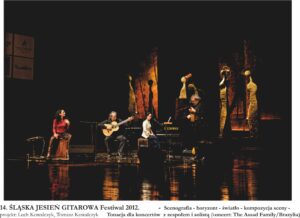
Photo: Lech Kowalczyk, Silesian Guitar Autumn 2012
Stage design, backdrop, lighting and stage composition conceived and realised by Lech Kowalczyk and Tomasz Kowalczyk for the concert by the Brazilian Assad Family at the Mały Theatre in Tychy.
Within such a carefully constructed space, a concert ceased to be merely a presentation of musical works. It became a meeting between two ways of understanding the world. Music created its invisible dimension, while the visual arts gave it a visible counterpart. The two languages did not translate one another; instead, they remained in a state of tension from which a third value emerged: a shared experience. Listeners encountering sophisticated music no longer felt lost, and their minds could follow the composer’s intentions and ideas. As both listeners and spectators, they felt they had become part of, and participants in, an imagined world.
Perhaps it was at that moment that listeners also ceased to ask what in the music imitated birdsong, the rustling of a forest, dance, ritual or the sounds of nature. They stopped searching for literal meanings and began to listen more deeply. The image helped them move beyond the surface of sound and enter its inner structure—its emotion, idea, tension, memory and the creative intention of the composer. The stage design did not say, “This is what you are hearing.” Rather, it said: “This is the space in which you can experience it.”
For it is precisely in such a space that transcendence begins. The musician, the sound of the instrument, the stage environment, the light and the audience cease to function as separate elements. They intertwine in a single experience—a form of shared feeling and mutual understanding for which no single language is sufficient. There is music, there is image, there is light, and there is the imagination of the audience.
At its finest, such stage design disappears as “stage design”. What remains is simply a world in which music could unfold more fully.
Lech Kowalczyk
Visual artist and stage designer, creator of the visual presentation and visual identity of the International Guitar Festival and Competition “Silesian Guitar Autumn” in Tychy from 1986 to 2014.
For more information, visit the artist’s page: LECH KOWALCZYK ART.
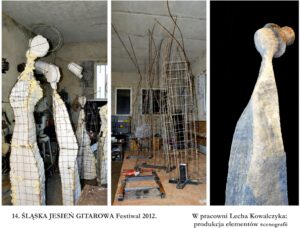
Photo: Lech Kowalczyk
In Lech Kowalczyk’s studio, producing stage-design elements for the 2012 Silesian Guitar Autumn Festival.