
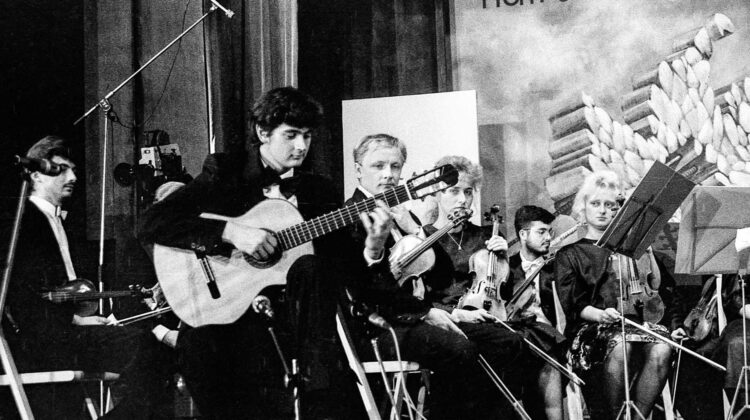
Only weeks separate us from the double anniversary of the Silesian Guitar Autumn. This October will see the 20th edition of the festival, while four decades will also have passed since the very first edition, held in 1986.
Forty years ago, on October 2, 1986, a dream came true for Jan Edmund Jurkowski, a composer and guitarist living in Tychy, then on Engelsa Street, but above all a lecturer at the Katowice Academy of Music. Travelling around Europe and attending numerous festivals, he came to the conclusion that there was no rule requiring events of this kind to be organised exclusively in metropolises or major cities. If it had been possible in the Greek city of Volos, with a population of just several tens of thousands, or in Esztergom in Hungary, which had even fewer inhabitants, then why shouldn’t it be possible in Tychy?!
Jurkowski won over the Tychy City Office to his idea – specifically Jan Kulbicki, head of the Department of Culture and Art – as well as his alma mater and the cultural authorities of the voivodeship. As a result, on that October 2 (unusually, it was a Thursday), someone could stand on the stage of the Teatr Mały and announce the words: “I hereby declare the International Silesian Guitar Autumn Festival open.”
It is worth remembering that this was the final period of the Polish People’s Republic, a time when everything – including funding for organising such an event – was difficult to obtain, and only a select few could afford to invite artists from behind the so-called Iron Curtain, meaning from Western countries. Tychy, however, had Jurkowski and his “connections” within guitar circles around the world. A well-liked and exceptionally outgoing person, he had little trouble persuading European and world-class guitar stars to perform at his festival, often for fees several times lower than those they would have received elsewhere. They did it simply “for Edmund” and partly out of curiosity to see how an international event could be organised in a relatively small city like Tychy.
And it worked. During the first edition, the stage of the Teatr Mały hosted not only outstanding Polish guitarists and musicians from friendly East Germany, Czechoslovakia, Cuba and Hungary, but also virtuosos from Austria, Mexico, Greece and even the United States. Gregory Newton is said to have been the first American classical guitarist in history to perform in Poland. At the second edition, Argentina, Brazil, Switzerland and West Germany were added to the list of countries represented by artists in Tychy. And from there, the festival simply kept growing…
When writing about that first celebration of the guitar in Tychy, it is worth mentioning that the Hotel Tychy is the same age as the Silesian Guitar Autumn. It was opened almost in time for the festival, while the auditions for the competition for young guitarists were held at the Górnik Community Centre in Housing Estate A (the building that now houses the music school was still occupied at the time by the Municipal Committee of the Polish United Workers’ Party). Festival participants – including the biggest international stars – travelled for their meals to… the FSM factory canteen in Housing Estate H.
For the city and the people of Tychy, that first Silesian Guitar Autumn was an event of enormous significance. The Teatr Mały audience regularly exceeded the theatre’s official capacity, and concerts ended with numerous encores. The festival guests returned home with such memorable experiences, and many of them came back to the festival in later years.
And so it has continued for forty years…
Wojciech Wieczorek